





Port Crane Wire Rope Inspection: Signs of Wear and Replacement
September 16,2026
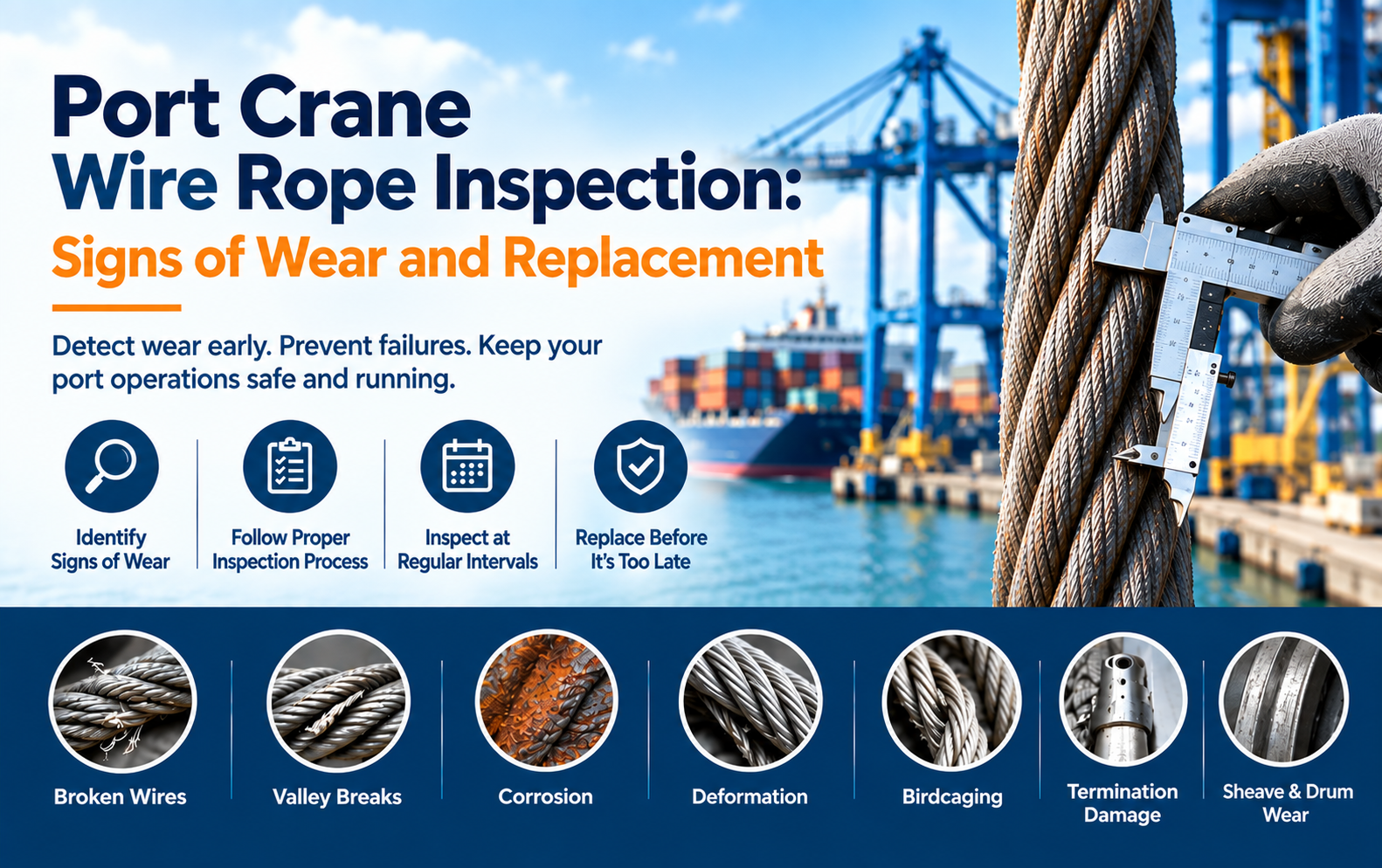
A wire rope failure on a port crane isn't a minor breakdown. it's a dropped load, a damaged vessel, or worse, a fatality. Yet many operators still rely on a single "percentage rule" to decide when a rope needs replacing. That's not enough. Replacement should be governed by whichever discard criterion applies first: the crane manufacturer's manual, the relevant law, or a governing standard such as ISO 4309:2017, which specifically addresses inspection and discard for portal, floating, offshore, and multi-layer-spooled cranes.
What to Look For
A few warning signs demand immediate attention from a competent inspector:
• Broken wires. Guidance commonly flags six randomly distributed broken wires in one lay, or three within a single strand in one lay, though the exact limit depends on rope construction, duty, and crane type.
• Valley breaks. Two or more broken wires in the valleys between strands in a single lay is a serious defect that usually calls for immediate removal.
• Diameter loss. Measure against the original nominal diameter with a proper rope caliper. A 7% reduction is a widely used benchmark, but always check the applicable standard or supplier specification.
• Deformation. Kinks, dog-legs, crushing, or flattening point to poor spooling, side loading, slack-rope operation, or contact with a damaged sheave.
• Birdcaging or core protrusion. Any strand separation or core extrusion is high-severity and non-negotiable.
• Corrosion. Marine air, saltwater, humidity, and cargo residue can corrode a rope internally long before it shows on the surface.
• Heat or electrical damage. Discoloration, fused wires, melted lubricant, or arc marks suggest overheating or an electrical fault.
• Termination damage. Sockets, clips, thimbles, and wedge ends should be checked for cracks, slippage, corrosion, and clustered wire breaks.
• Abnormal behaviour. Jumping, vibration, uneven winding, rotation, or unusual noise often signal a hidden rope or sheave problem.
The Inspection Method
1. Isolate the crane. Lock out, tag out, and secure the load-handling equipment before touching the rope.
2. Clean the rope.Remove dirt and grease so breaks, corrosion, and deformation are actually visible.
3. Inspect the full running length. Slow, deliberate checks over sheaves and onto the drum, especially sheave contact zones, crossover points, reverse-bend areas, and sections hidden on the drum.
4. Count broken wires per lay and per strand, using a cloth drawn along the rope (carefully, with gloves) to catch protruding ends.
5. Measure diameter at multiple points and in two perpendicular directions, focusing on the most worn sections.
6. Check sheaves and drum grooves. A worn, misaligned, or damaged groove will wear out a new rope just as fast as the old one — fix the root cause, not just the symptom.
7. Verify terminations and reeving — rope direction, fleet angle, socket and wedge installation, clips, and guards.
8. Consider magnetic rope testing for internal wire breaks and metallic loss that visual checks can miss — a method ISO 4309:2017 formally incorporates.
How Often to Inspect
• Every shift: a quick visual check for obvious breaks, kinks, birdcaging, and abnormal reeving.
• Periodic documented inspection: full examination with wire counts and diameter measurements.
• After any abnormal event, shock loading, overload, side pulling, snagging, power-line contact, or flooding.
• After installation or re-reeving, to confirm correct seating and running-in.
• More frequently in marine service, where salt, humidity, heavy grabs, and multi-layer spooling accelerate wear.
The right interval isn't a fixed number. It's set jointly by the manufacturer, port safety rules, rope supplier, and a competent lifting-equipment inspector based on actual duty cycle.
When to Replace, Not Repair
Replace the rope when any mandatory discard limit is crossed, when there's severe distortion or core failure, when corrosion has meaningfully reduced metallic cross-section, or when an overload event leaves its condition uncertain. If inspection records show steady deterioration trending toward the limit, don't wait for the threshold to be crossed before acting.
One rule holds regardless of the situation: never splice, weld, hammer straight, or locally repair a crane hoist rope to stretch its life. Replace it with the exact diameter, construction, grade, lay, core, and coating the crane specifies, and make the final call against the manufacturer's instructions and applicable standard, not a generic number found online.
Wire rope wear rarely announces itself until it's a problem. Connect with PORTECH for scheduled, comprehensive testing and maintenance that catches deterioration before it becomes downtime.