





Port Crane Breakdown Troubleshooting: Common Problems and Solutions
October 14, 2026
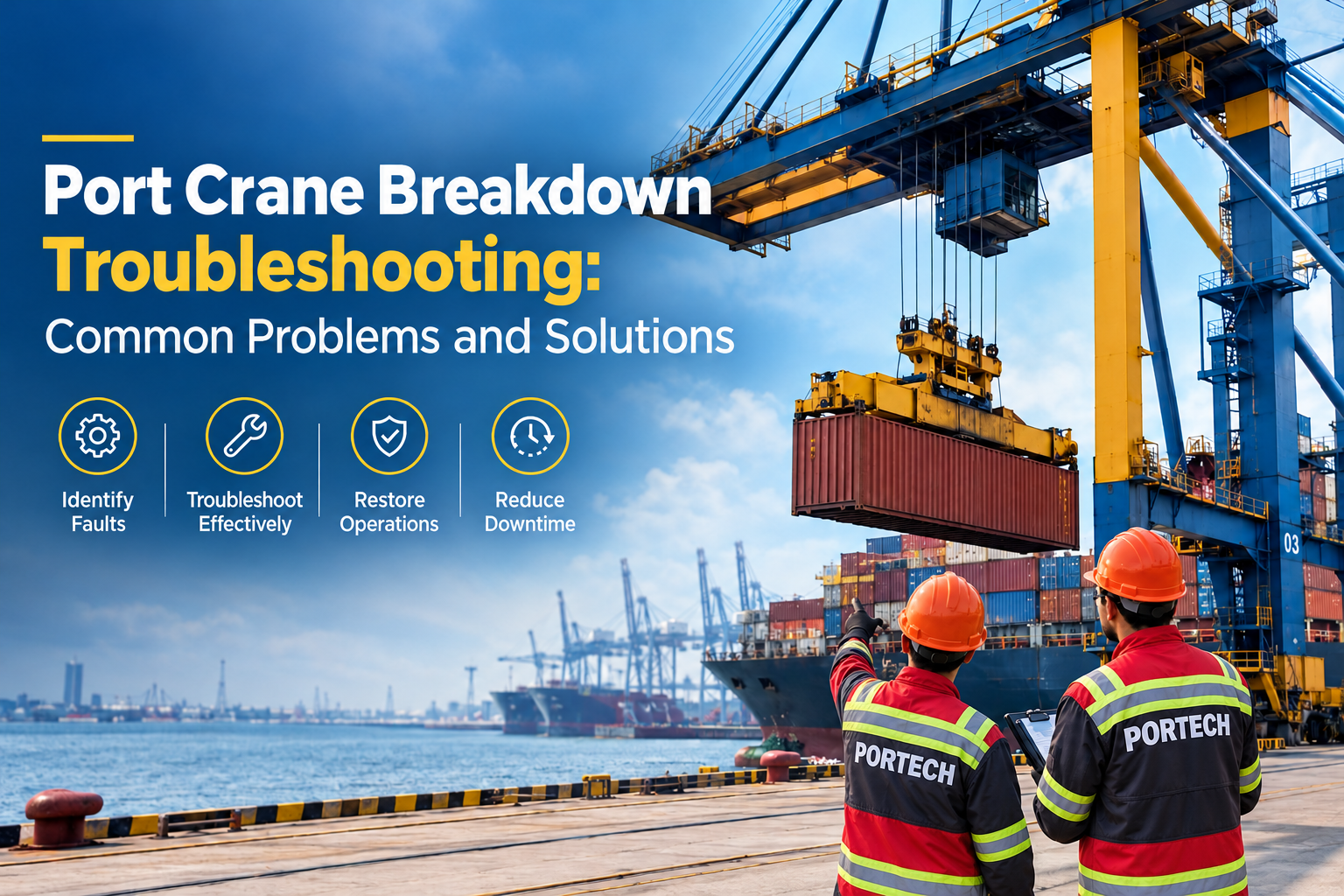
Unplanned crane downtime at a port terminal carries a cost that extends well beyond the repair bill. Berth windows are lost. Vessel schedules are disrupted. And the maintenance team is expected to diagnose, resolve, and return the crane to service under significant operational pressure.
What determines the outcome in those situations is the discipline to follow the right diagnostic sequence when speed is the instinct. Faults that are reset without being understood tend to return. Problems that are partially addressed tend to escalate.
At PORTECH, we have responded to breakdowns on port cranes across crane types and terminal environments. What separates a fast, effective recovery from a repeated one is usually not technical knowledge alone. It is the discipline to follow the right sequence under pressure. This blog walks through that sequence and the most common failure areas we encounter on port cranes.
The First Priority: Make the Crane Safe
Before any diagnosis begins, the crane needs to be made safe. This means stopping operations immediately, cutting main power or shutting down the engine, isolating hydraulic sources, and venting stored energy, but only in accordance with the OEM's specified procedure. Stored energy in hydraulic accumulators and spring-applied brakes can cause sudden, unexpected movement if released incorrectly.
While making the crane safe, capture as much information as possible: fault codes from the PLC or drive, what the operator observed before the fault, the load being handled, weather conditions, and whether the fault appeared suddenly or had been intermittent. This information is the starting point for diagnosis and it disappears quickly if not recorded in the moment.
A quick visual scan follows: oil on the ground, the smell of burnt wiring, loose connectors, damaged cables, corrosion, cracks, abnormal tyre condition, or anything that looks obviously wrong. Often, the most important finding in a breakdown is visible before any instrument is picked up.
Common Failure Areas and How to Approach Them
Crane Will Not Start or Controls Are Dead
The most common cause of a completely unresponsive crane is something in the electrical control circuit, a blown fuse, a tripped breaker, a loose terminal, or an emergency-stop circuit that hasn't reset properly. In port environments, vibration and moisture work together over time to loosen electrical connections and degrade terminals in ways that aren't obvious on a casual inspection.
Check control power, fuses, breakers, and battery voltage first. Verify that every emergency-stop button in the circuit has been properly reset, a single unreset e-stop anywhere in the chain will prevent the crane from starting. Check PLC and drive fault codes, which often point directly to the problem. Tighten any terminals that show signs of movement or corrosion.
Hoist, Trolley, or Travel Drive Trips
Drive trips on port cranes most commonly come from overheating, encoder faults, or cable insulation issues. In coastal environments, dust and salt accumulation on braking resistors reduces heat dissipation and causes the drive to derate or trip — a failure mode that's easily missed if the resistor grid isn't included in regular cleaning schedules.
Read the drive fault codes before doing anything else. Check cooling fans and airflow paths. Inspect braking resistors for buildup. Verify encoder alignment and coupling condition. On festoon and trailing cable systems, check insulation condition and look for jacket damage — cable systems on busy STS cranes take significant mechanical stress over time.
Hoist Will Not Lift, Lower, or Hold Load
This is the failure mode with the most immediate safety implications because it directly involves a load. The causes split broadly into hydraulic, brake, and electrical categories.
Check hydraulic fluid level and condition first — low or contaminated fluid is a frequent culprit. Check filters, hoses, and pump operation. Review the brake hydraulic circuit. Check the load limiter and look at recent records for any indication of an overload event. If a load is currently suspended, the priority is controlled lowering before any further diagnosis.
Never attempt to lift an overloaded or improperly rigged load, and never bypass a load limiter to attempt a recovery. A load limiter that has triggered has done its job and investigate why before resetting it.
Hydraulic System Problems
Hydraulic faults on port cranes typically present as drift, pressure loss, or sluggish and jerky movement. The diagnostic starting point is always fluid level and condition, low fluid levels can cause cavitation, aeration, and sudden steering loss on RTGs, often before any other symptom is obvious.
For a cylinder that drifts or loses pressure, isolate it with manual valves and perform a load-hold test. A pressure drop of more than 10% in 60 seconds at working pressure typically indicates piston seal leakage requiring replacement. After any hydraulic repair involving disassembly, replace filters and bleed air from the system before returning to service.
Slow or jerky movement without obvious leakage usually points to contaminated or aerated fluid, a clogged filter, or a worn pump. Investigate suction lines for air ingress and check pump noise, cavitation has a distinctive sound that an experienced ear will recognise.
Wire Rope Problems
Wire rope issues range from visible and immediately dangerous — a severed rope or birdcaged strand — to subtle and easily missed, such as internal core deterioration or valley wire breaks that don't show on the surface.
Inspect rope condition against ISO 4309 criteria, checking for broken wires, corrosion, diameter reduction, and core deformation. Check drum grooves, sheave condition, and spooling pattern. A rope that has birdcaged has experienced sudden shock loading — before replacing the rope, understand what caused it, because the same event that damaged the rope may have stressed other components as well.
Replace rope immediately if it is severed, birdcaged, or shows deterioration that crosses the retirement criteria under ISO 4309. Return to service on a new rope without resolving the condition that caused the failure is not a solution.
Abnormal Noise from Hoist or Travel Gear
Noise is one of the most information-dense signals a crane gives. The location and character of noise points directly to the source: gearbox whine suggests gear wear or lubrication breakdown; grinding at wheel or axle locations suggests bearing wear, flat spots, or rail misalignment; brake squeal or grinding indicates contamination or adjustment problems.
Take the time to locate the noise accurately before opening anything. Running a crane to confirm a noise location is sometimes necessary, but do it briefly and with someone positioned safely to observe. Gearbox oil should be inspected for metal particles — this is a critical finding that indicates internal wear requiring further assessment before the crane returns to full duty.
Crane Tracking and Wheel Wear
Rail-mounted cranes that are tracking incorrectly, or showing uneven or rapid wheel wear, almost always have an underlying alignment or rail condition issue. Laser alignment to approximately ±0.5mm is the standard to work towards. Check rail bolt torque — vibration loosens rail fixings progressively, and loose rails cause impact loading on every wheel pass. Replace wheels when diameter loss across the set exceeds 10%, as uneven wheel diameters compound the alignment problem.
Spreader Locking Problems
Spreader lock and unlock faults are frequently sensor-related rather than mechanical. The inductive sensors that detect twistlock position are exposed to the same salt, humidity, and impact environment as everything else, and they drift out of specification or collect contamination on the sensing face.
Clean the sensor face, verify the sensing gap against the specified setting — typically around 4mm — and check for signal bounce. If signal bounce exceeds acceptable limits, adjust the gap before assuming a mechanical fault. If the mechanical lock itself is involved, check the hydraulic circuit and the physical condition of the twistlock mechanism.
Preventing the Next Breakdown
A fault ledger that links maintenance records, operator reports, and failure history is one of the most practical tools a terminal maintenance team can maintain. When breakdowns are documented properly — what failed, when, under what conditions, and what was found — patterns emerge that point to root causes rather than symptoms. The terminal that knows its cranes have a recurring drive trip every six to eight weeks in summer can investigate the cooling system before the next trip, not after.
Condition-based inputs — vibration analysis, thermography, lubrication monitoring, insulation resistance testing — give maintenance teams the information to act before components fail rather than in response to failure. Combined with strong operator feedback and regular visual inspections, they form the basis of a maintenance programme that reduces unplanned downtime progressively over time.
A Final Word on Return to Service
A crane should not return to service after a structural crack, rope failure, brake or load-holding fault, major hydraulic leak, or unresolved safety-circuit fault until a competent crane engineer has assessed and cleared it. The pressure to get a crane back working is real — but returning a crane to service with an unresolved safety fault is not a productivity decision. It is a safety one.
If you are dealing with a breakdown and need support with diagnosis, recovery, or a post-incident assessment, PORTECH's engineering team works across crane types and terminal environments across India.